

Fact of the Day - December
All of December’s North Shields 800 Facts of the Day in one place.
December 1st, 1884
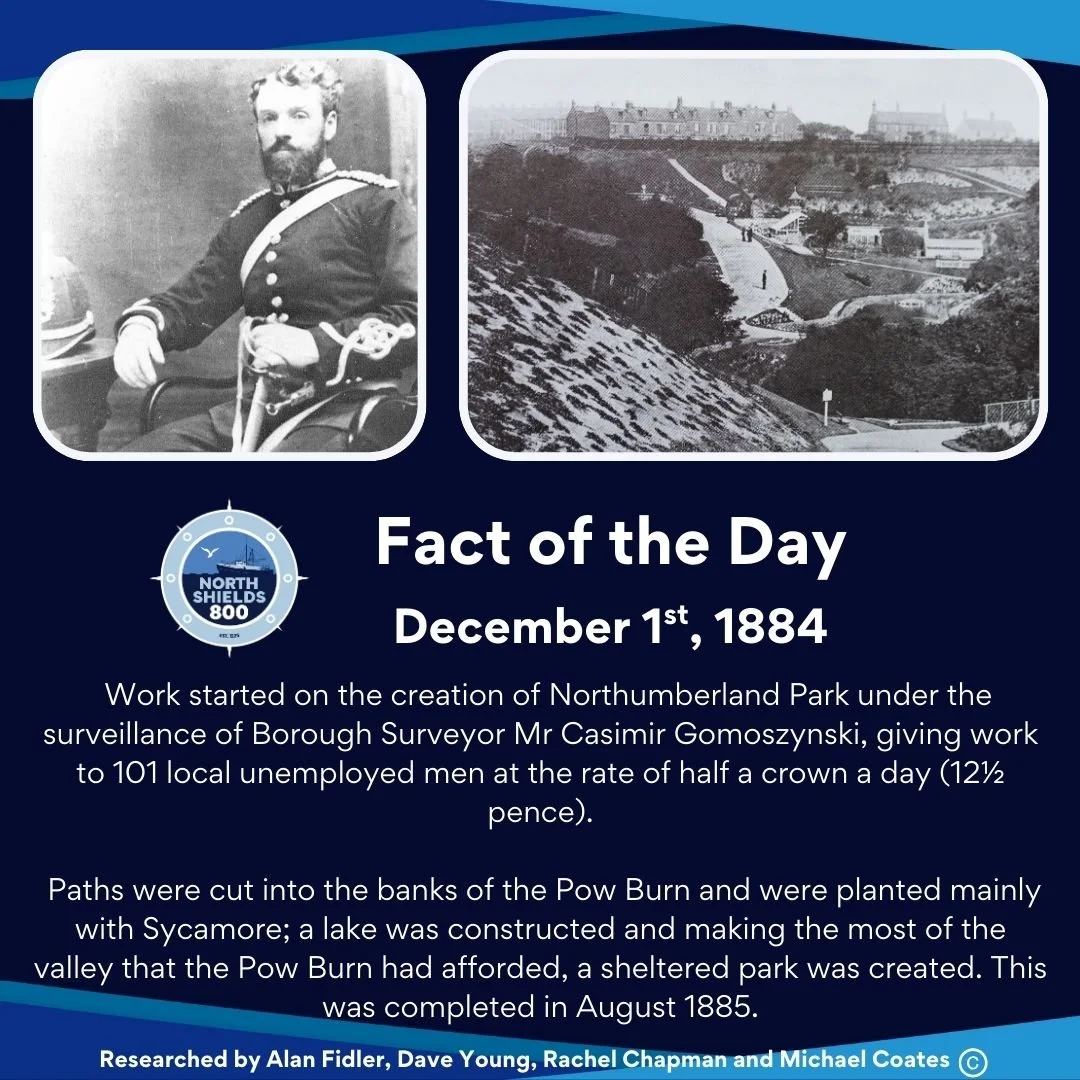
Work started on the creation of Northumberland Park under the surveillance of Borough Surveyor Mr Casimir Gomoszynski, giving work to 101 local unemployed men at the rate of half a crown a day (12½ pence).
Paths were cut into the banks of the Pow Burn and were planted mainly with Sycamore; a lake was constructed and making the most of the valley that the Pow Burn had afforded, a sheltered park was created. This was completed in August 1885.
December 2nd, 1851
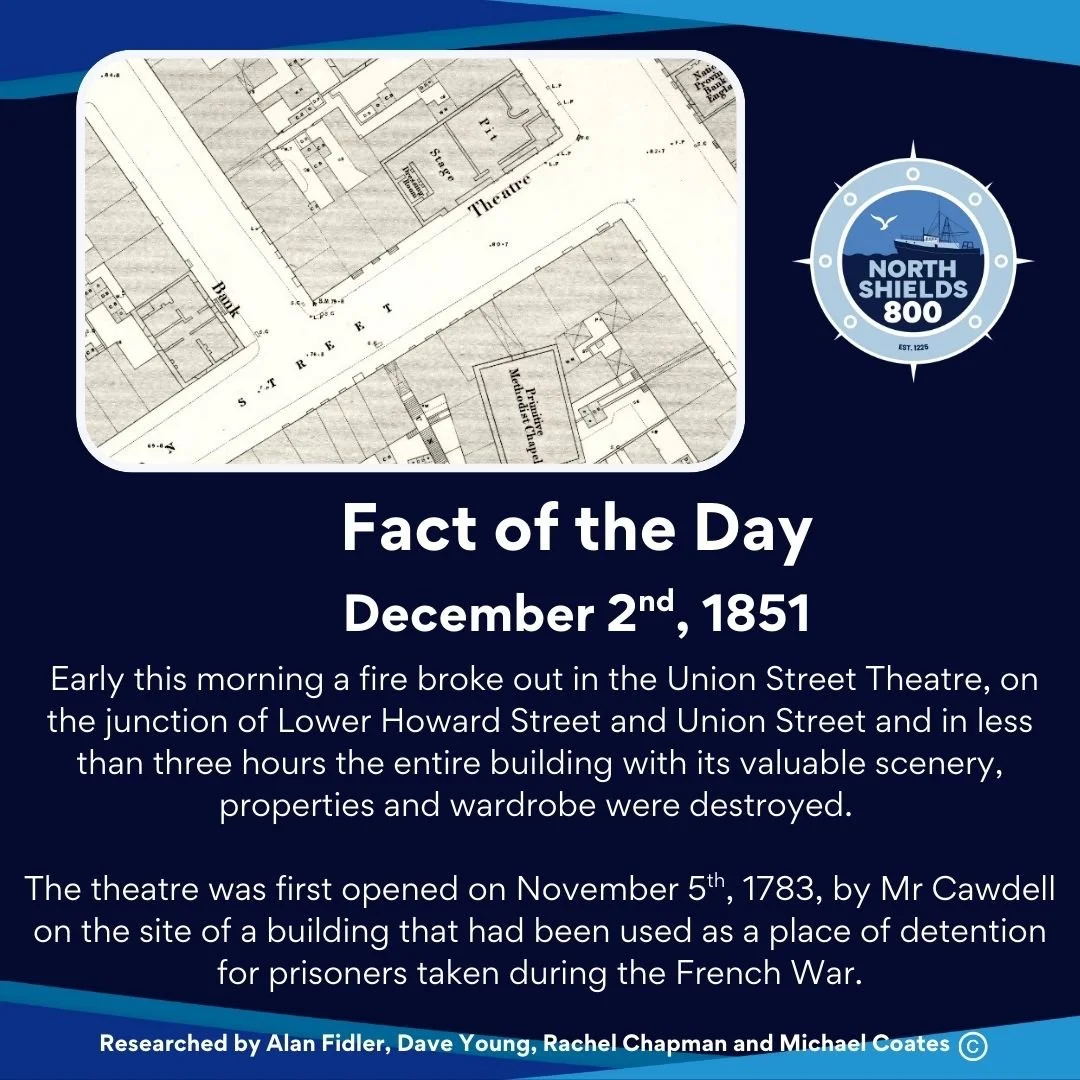
Early this morning a fire broke out in the Union Street Theatre, on the junction of Lower Howard Street and Union Street and in less than three hours the entire building with its valuable scenery, properties and wardrobe were destroyed.
The theatre was first opened on November 5th, 1783, by Mr Cawdell on the site of a building that had been used as a place of detention for prisoners taken during the French War.
December 3rd, 1965
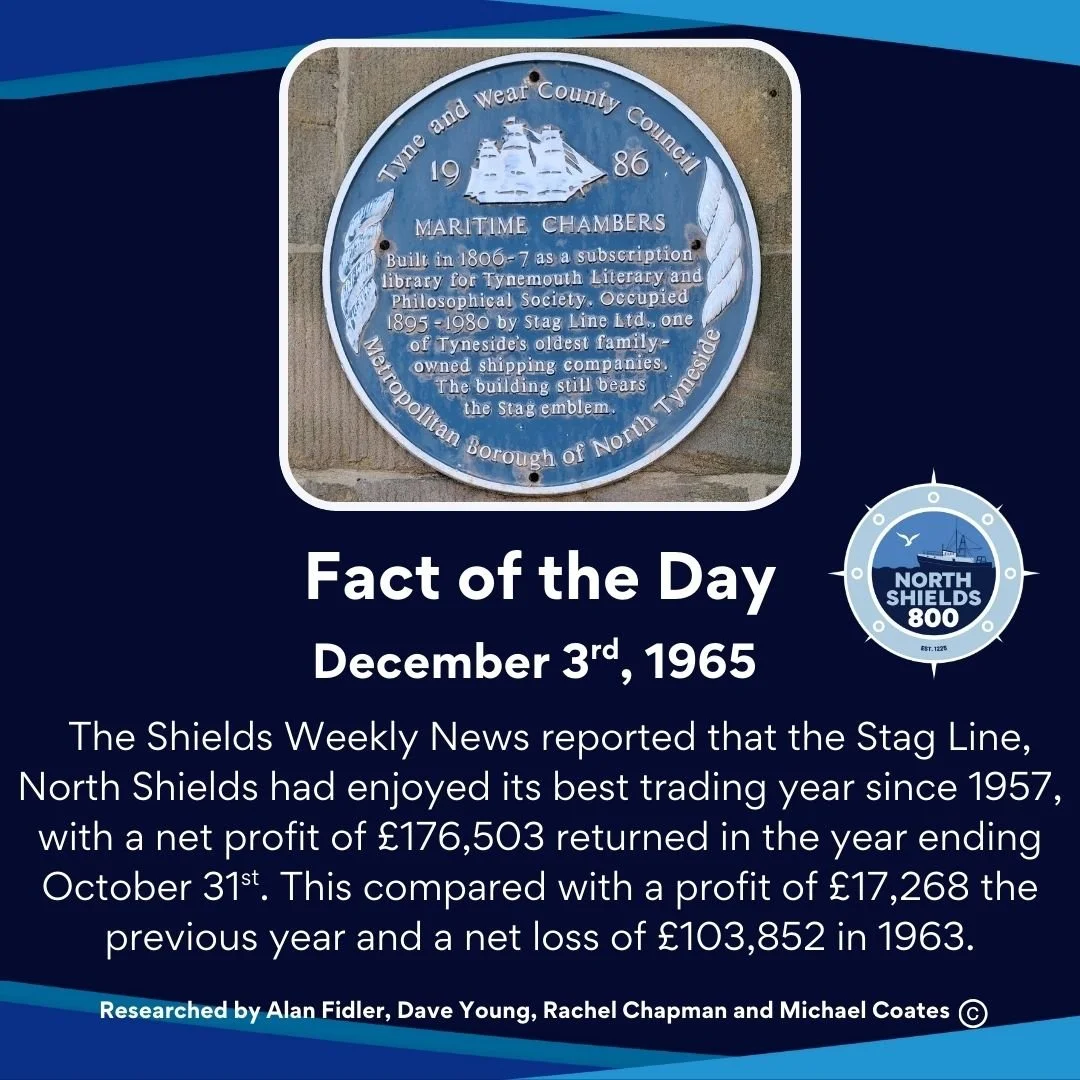
The Shields Weekly News reported that the Stag Line, North Shields had enjoyed its best trading year since 1957, with a net profit of £176,503 returned in the year ending October 31st. This compared with a profit of £17,268 the previous year and a net loss of £103,852 in 1963.
December 4th, 1849
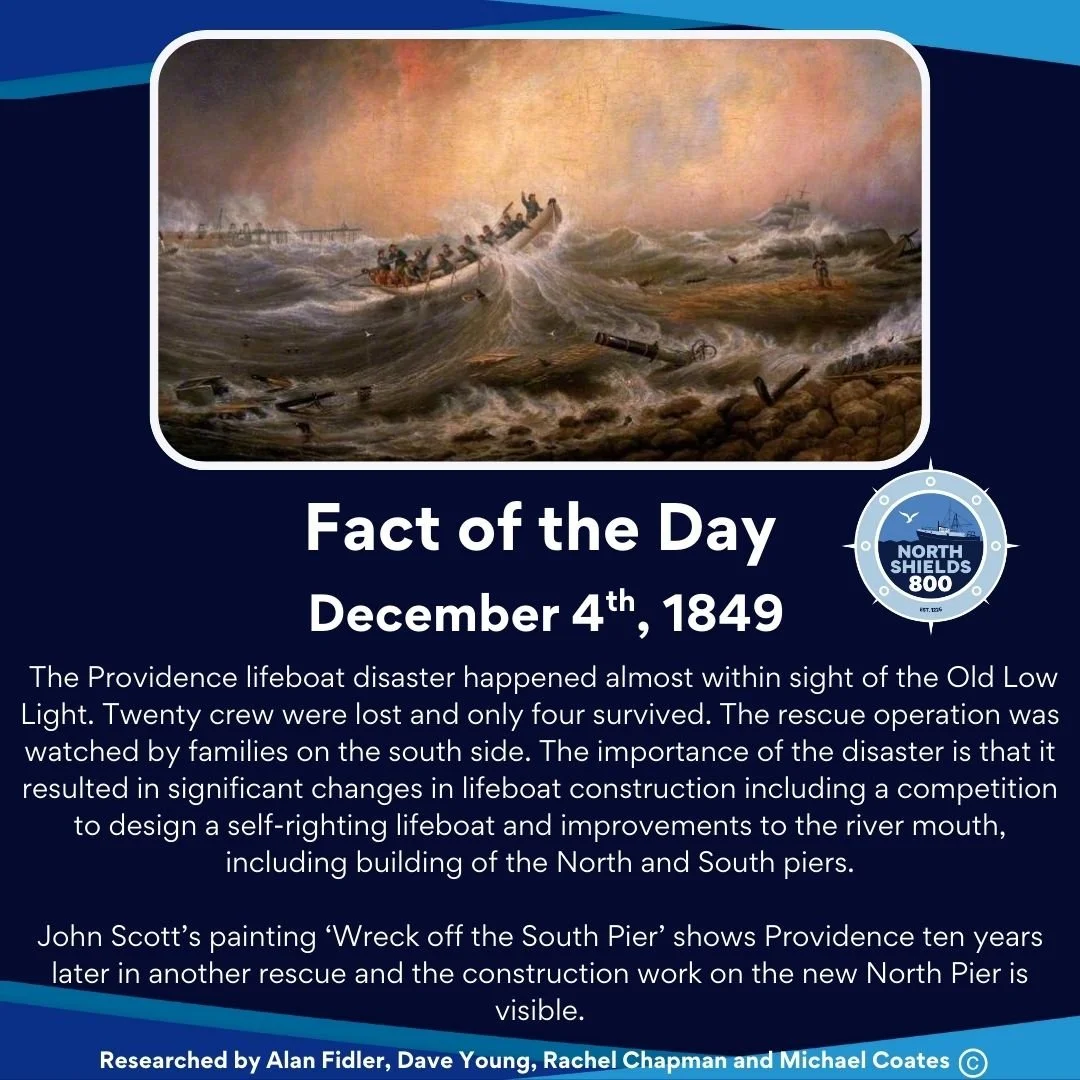
The Providence lifeboat disaster happened almost within sight of the Old Low Light. Twenty crew were lost and only four survived. The rescue operation was watched by families on the south side. The importance of the disaster is that it resulted in significant changes in lifeboat construction including a competition to design a self-righting lifeboat and improvements to the river mouth, including building of the North and South piers.
Pic – John Scott’s painting ‘Wreck off the South Pier’ shows Providence ten years later in another rescue and the construction work on the new North Pier is visible.
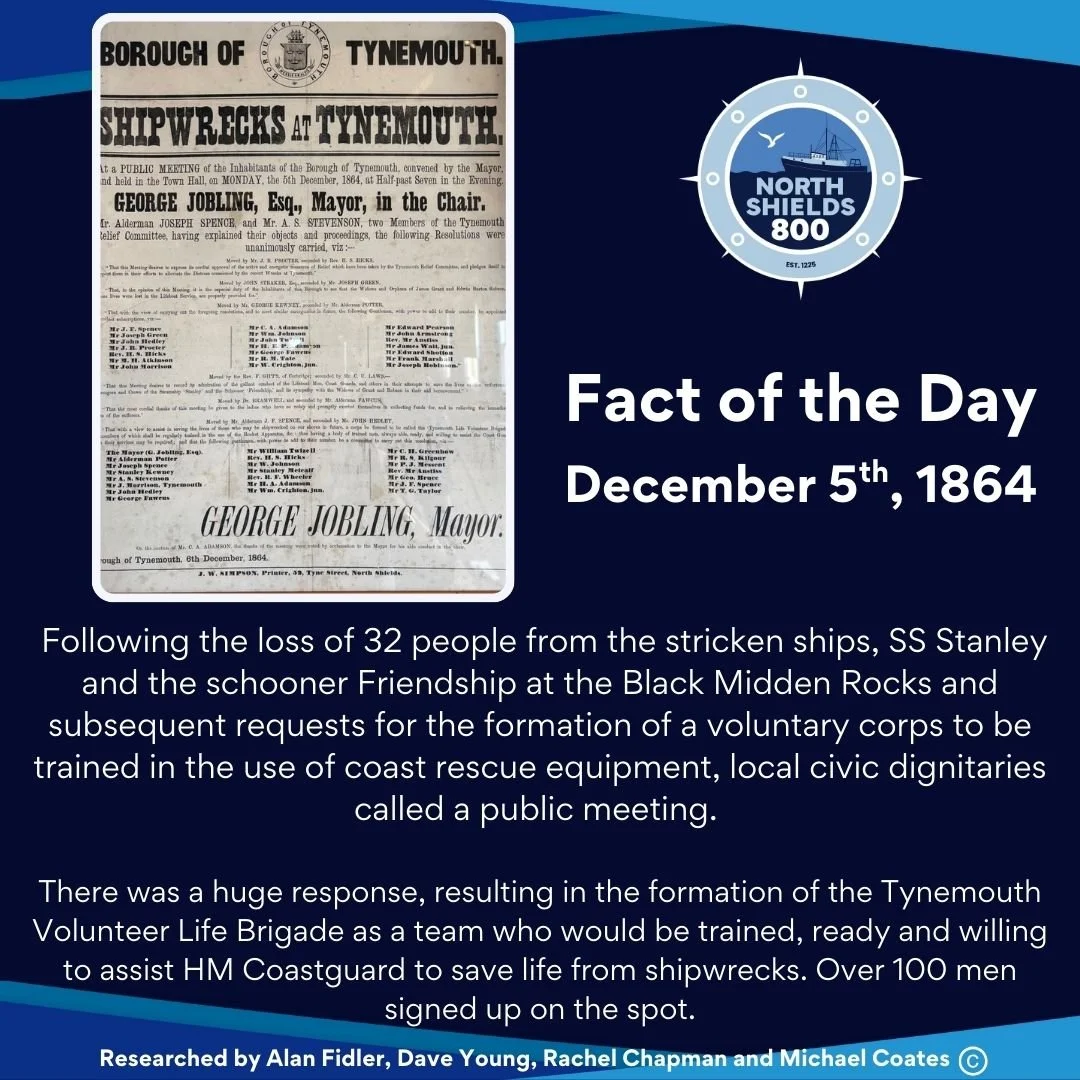
December 5th, 1864
Following the loss of 32 people from the stricken ships, SS Stanley and the schooner Friendship at the Black Midden Rocks and subsequent requests for the formation of a voluntary corps to be trained in the use of coast rescue equipment, local civic dignitaries called a public meeting.
There was a huge response, resulting in the formation of the Tynemouth Volunteer Life Brigade as a team who would be trained, ready and willing to assist HM Coastguard to save life from shipwrecks. Over 100 men signed up on the spot.
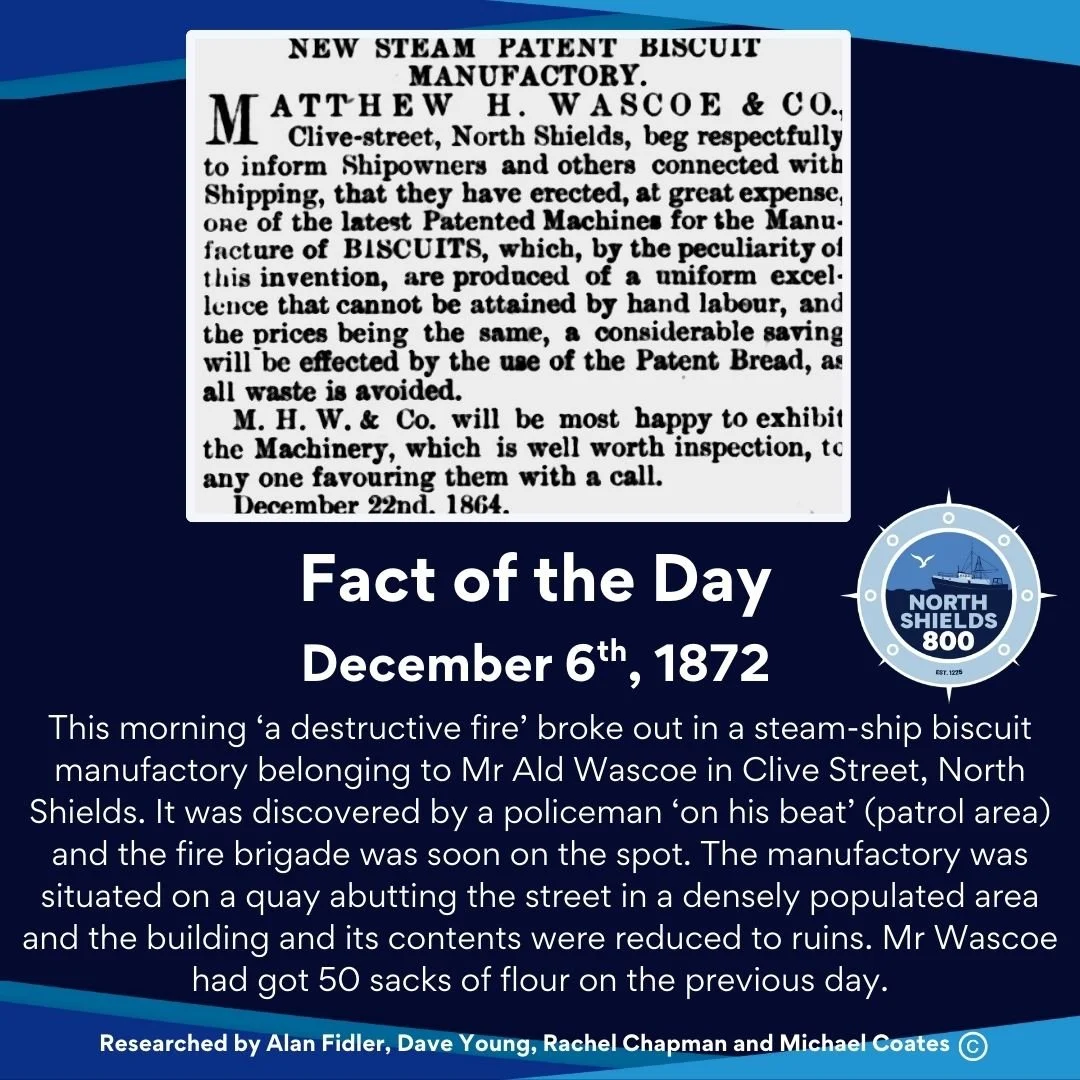
December 6th, 1872
This morning ‘a destructive fire’ broke out in a steam-ship biscuit manufactory belonging to Mr Ald Wascoe in Clive Street, North Shields. It was discovered by a policeman ‘on his beat’ (patrol area) and the fire brigade was soon on the spot.
The manufactory was situated on a quay abutting the street in a densely populated area and the building and its contents were reduced to ruins. Mr Wascoe had got 50 sacks of flour on the previous day.
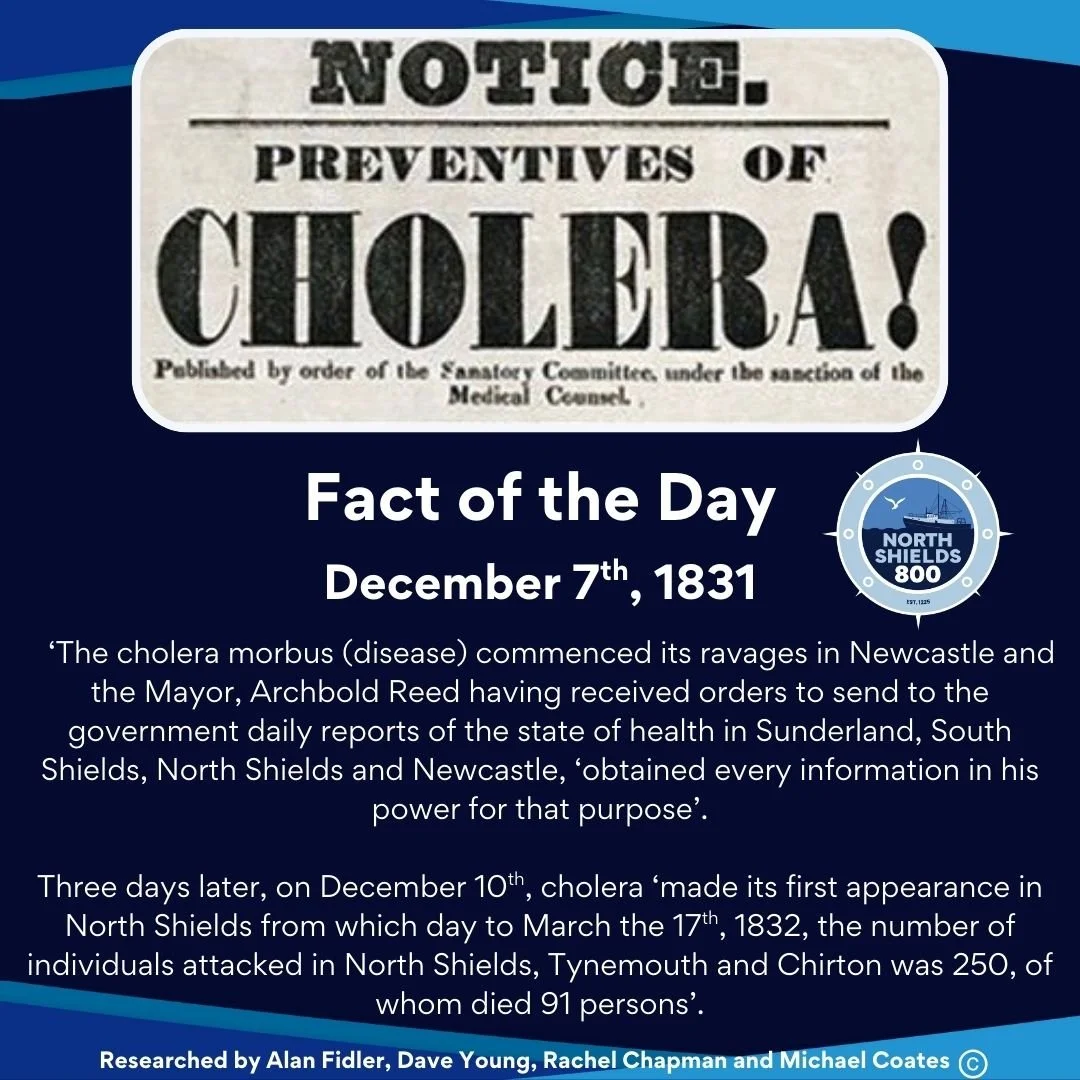
December 7th, 1831
‘The cholera morbus (disease) commenced its ravages in Newcastle and the Mayor, Archbold Reed having received orders to send to the government daily reports of the state of health in Sunderland, South Shields, North Shields and Newcastle, ‘obtained every information in his power for that purpose’.
Three days later, on December 10th, cholera ‘made its first appearance in North Shields from which day to March the 17th, 1832, the number of individuals attacked in North Shields, Tynemouth and Chirton was 250, of whom died 91 persons’.
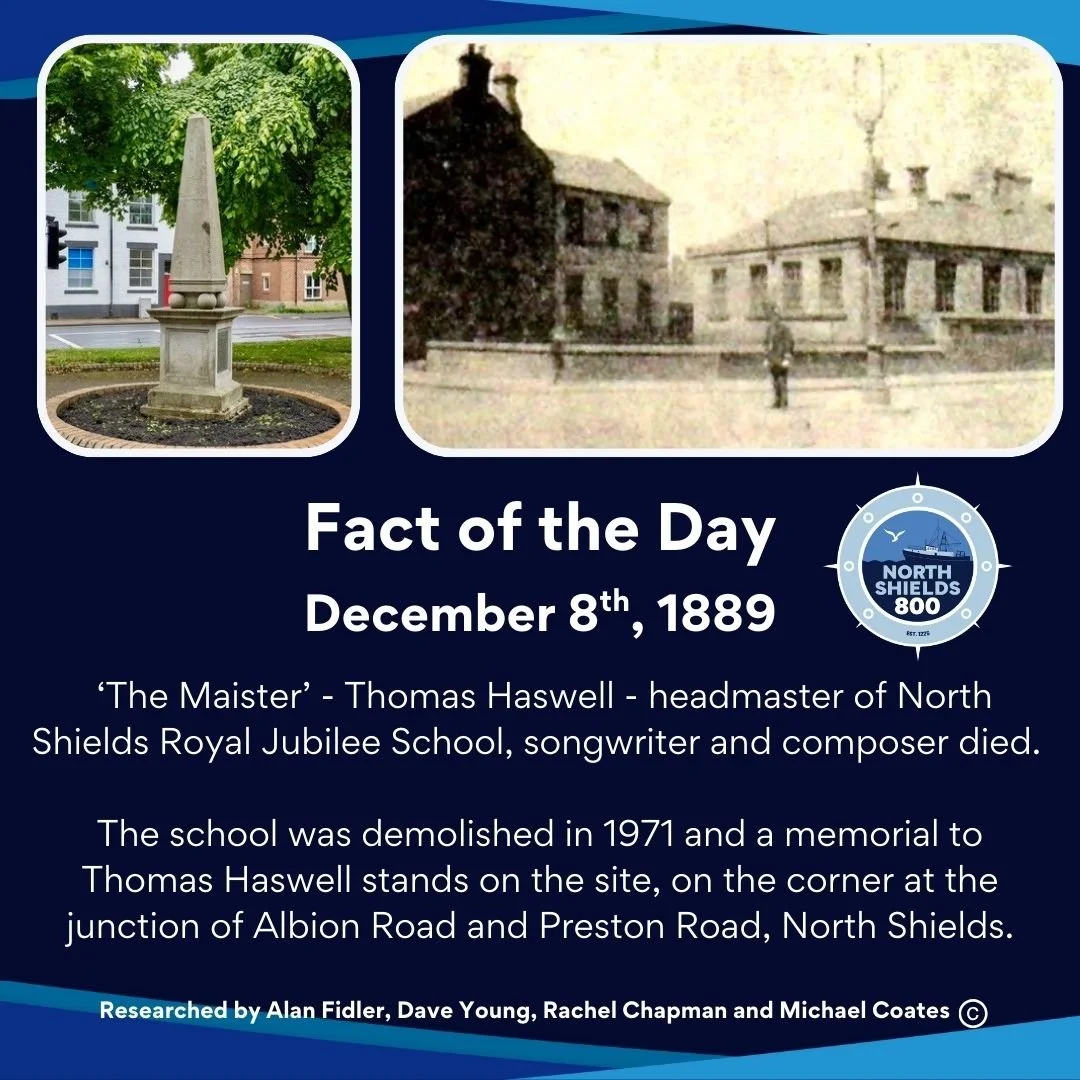
December 8th, 1889
‘The Maister’ - Thomas Haswell - headmaster of North Shields Royal Jubilee School, songwriter and composer died. The school was demolished in 1971 and a memorial to Thomas Haswell stands on the site, on the corner at the junction of Albion Road and Preston Road, North Shields.
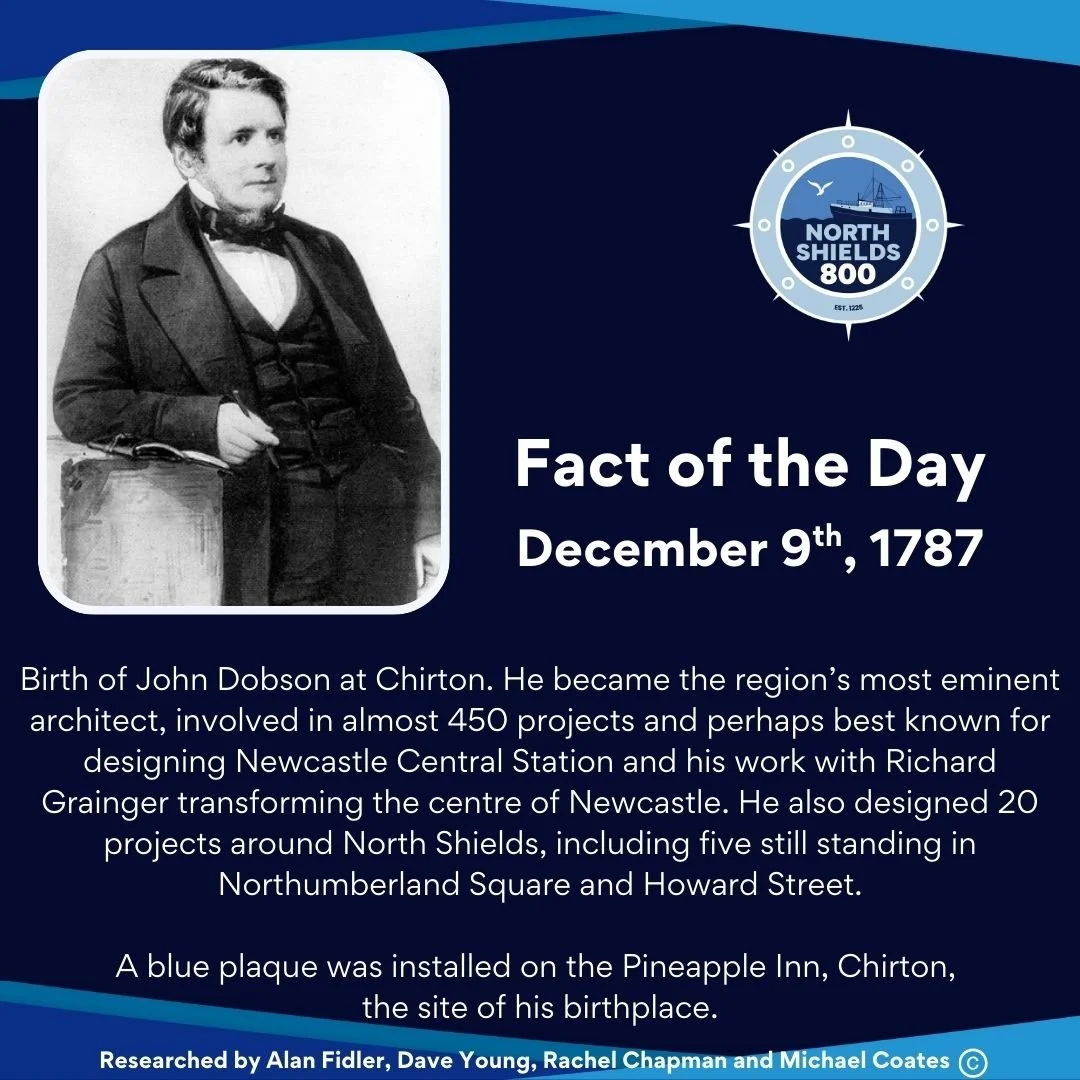
December 9th, 1787
Birth of John Dobson at Chirton. He became the region’s most eminent architect, involved in almost 450 projects and perhaps best known for designing Newcastle Central Station and his work with Richard Grainger transforming the centre of Newcastle. He also designed 20 projects around North Shields, including five still standing in Northumberland Square and Howard Street.
A blue plaque was installed on the Pineapple Inn, Chirton, the site of his birthplace.
December 10th, 1805
An extraordinarily high tide took place at Shields and the sea being very high caused the waves to break with great fury against the stone quay at the foot of Tynemouth barracks. Several of the wooden heads or breakwaters were torn from the front of the wall and smashed to pieces. The tide washed down the sentry box, near Clifford’s Fort, even though it was placed away from the water.
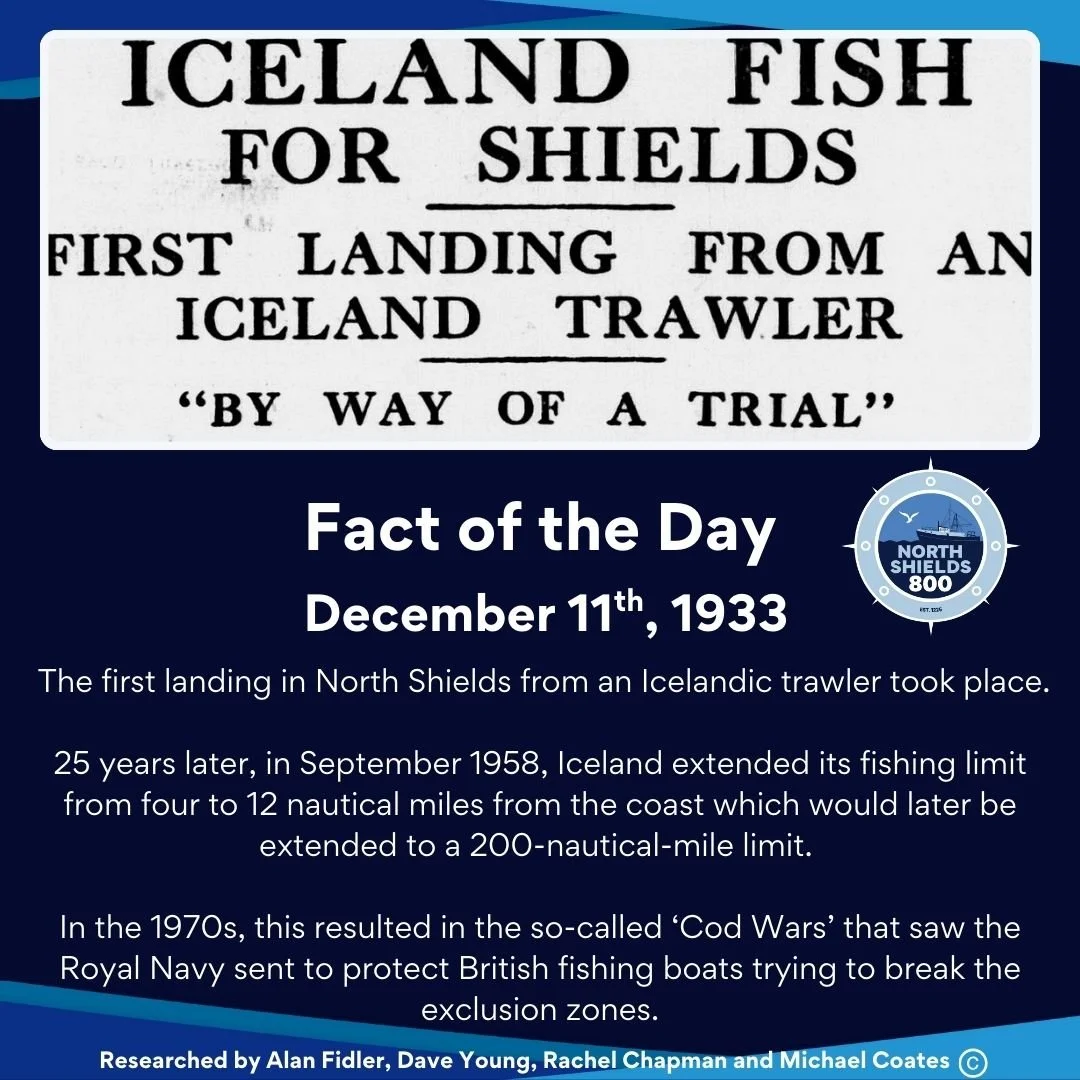
December 11th, 1933
The first landing in North Shields from an Icelandic trawler took place. The boat ’trialling’ the scheme was the ‘Hilmar’ out of Reykjavik.
Twenty-five years later, in September 1958, Iceland extended its fishing limit from four to 12 nautical miles from the coast which would later be extended to a 200-nautical-mile limit.
In the 1970s, this resulted in the so-called ‘Cod Wars’ that saw the Royal Navy sent to protect British fishing boats trying to break the exclusion zones.
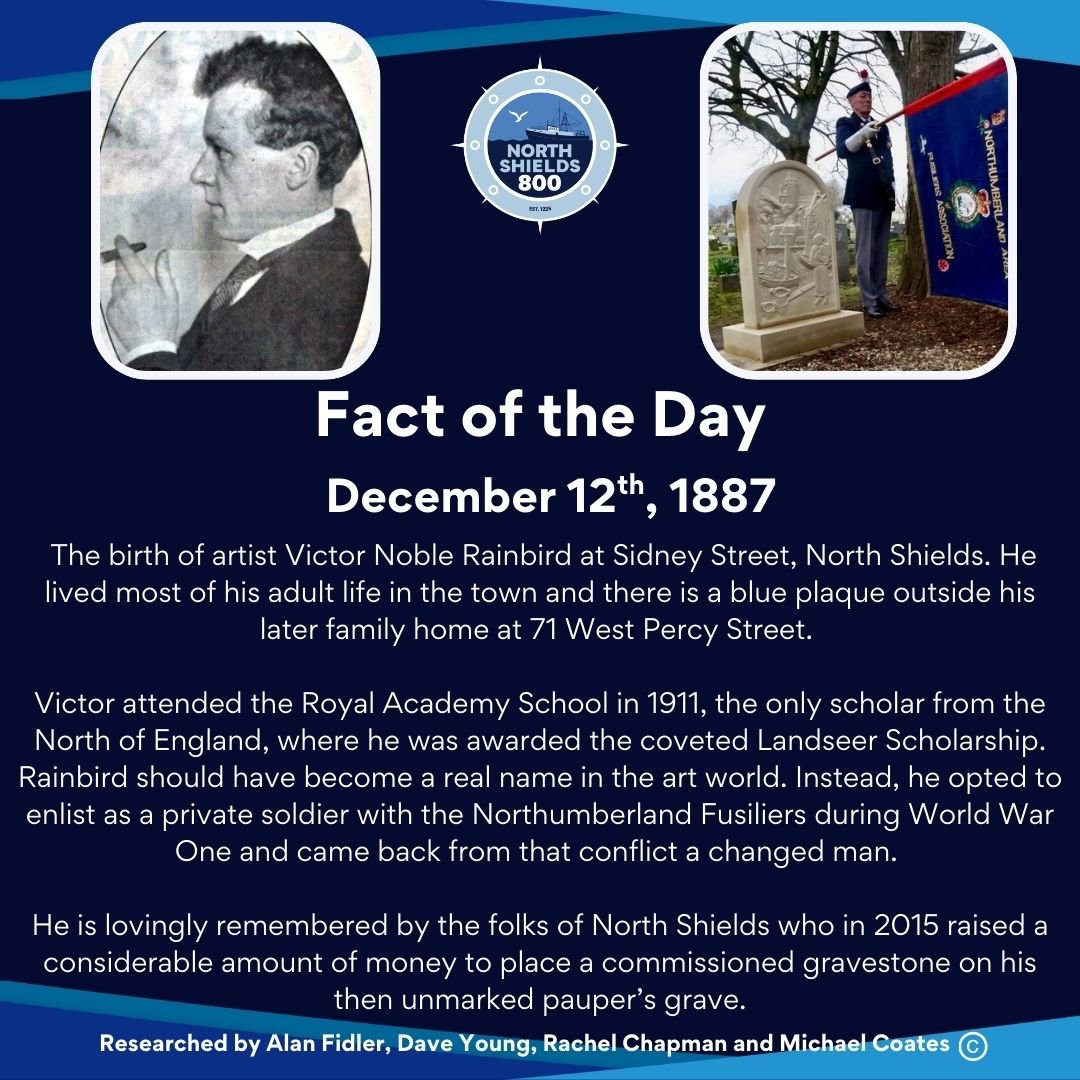
December 12th, 1887
The birth of artist Victor Noble Rainbird at Sidney Street, North Shields. He lived most of his adult life in the town and there is a blue plaque outside his later family home at 71 West Percy Street.
Victor attended the Royal Academy School in 1911, the only scholar from the North of England, where he was awarded the coveted Landseer Scholarship. Rainbird should have become a real name in the art world. Instead, he opted to enlist as a private soldier with the Northumberland Fusiliers during World War One and came back from that conflict a changed man.
He is lovingly remembered by the folks of North Shields who in 2015 raised a considerable amount of money to place a commissioned gravestone on his then unmarked pauper’s grave.
December 13th, 1870
In a report by the Durham Mining Museum, William Oastler, aged 13, is listed as dying following an accident at Preston Colliery, where he was employed to drive the horses pulling the coal tubs on the main roadway underground. He was crushed by a horse crank and pump.
Over the years, until its closure in 1929, Preston Colliery was a major employer in North Shields.
December 14th, 1989
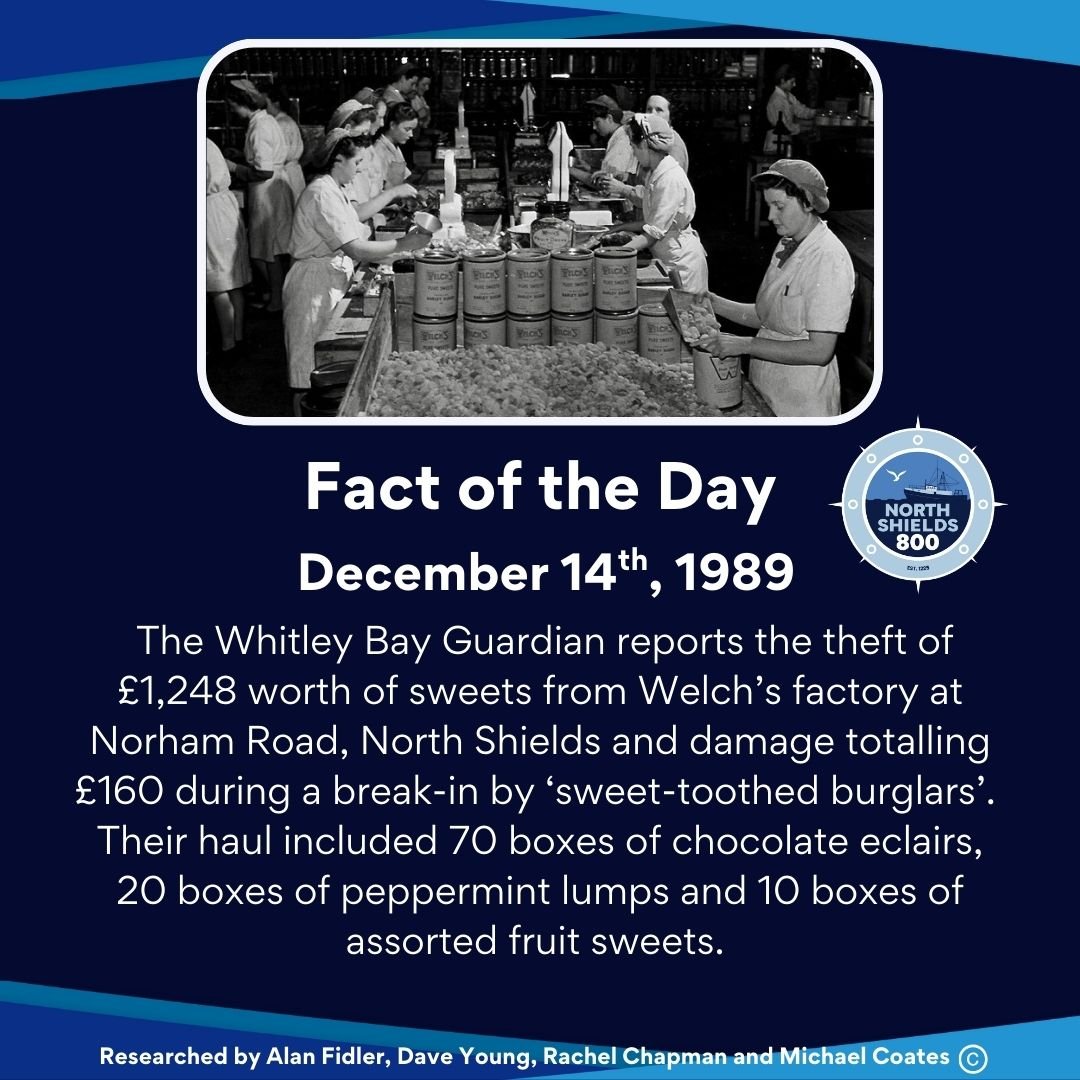
The Whitley Bay Guardian reports the theft of £1,248 worth of sweets from Welch’s factory at Norham Road, North Shields and damage totalling £160 during a break-in by ‘sweet-toothed burglars’.
Their haul included 70 boxes of chocolate eclairs, 20 boxes of peppermint lumps and 10 boxes of assorted fruit sweets.
December 15th, 1870
Died at his residence, Northumberland Square, North Shields after a short illness of little more than a week, Mr James Philip Dodd in his 67th year.
He was much connected with education in the town since 1827 and before commencing an academy of his own, he was an assistant with his father-in-law, the late Rev W Leitch, who was the father of the Town Clerk.
Mr Dodd was also one of the founders of the North Shields Mechanics’ Institution and a secretary of the Literary and Philosophical Society.
December 16th, 1869
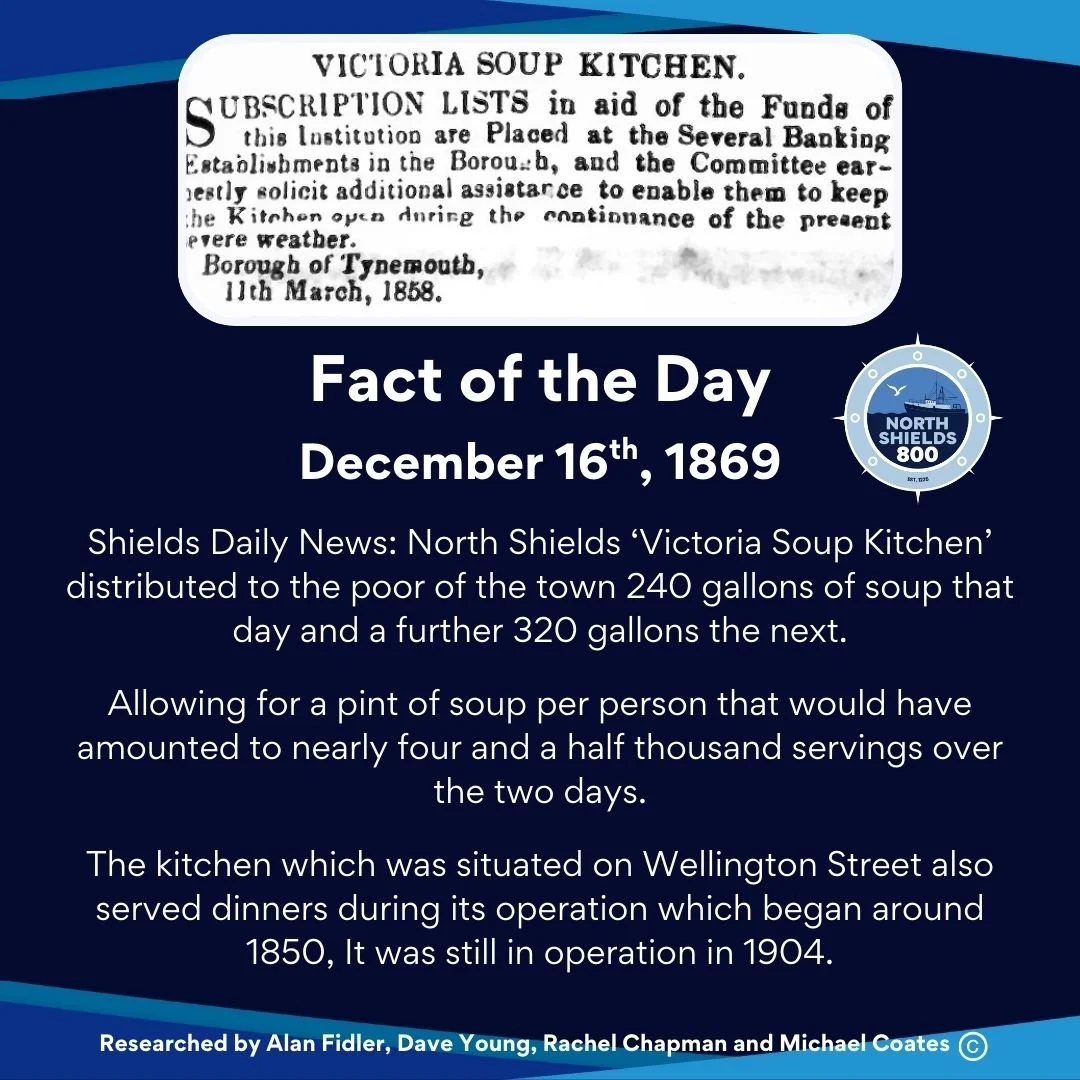
Shields Daily News: North Shields ‘Victoria Soup Kitchen’ distributed to the poor of the town 240 gallons of soup that day and a further 320 gallons the next.
Allowing for a pint of soup per person that would have amounted to nearly four and a half thousand servings over the two days.
The kitchen which was situated on Wellington Street also served dinners during its operation which began around 1850, It was still in operation in 1904.
December 17th, 1889
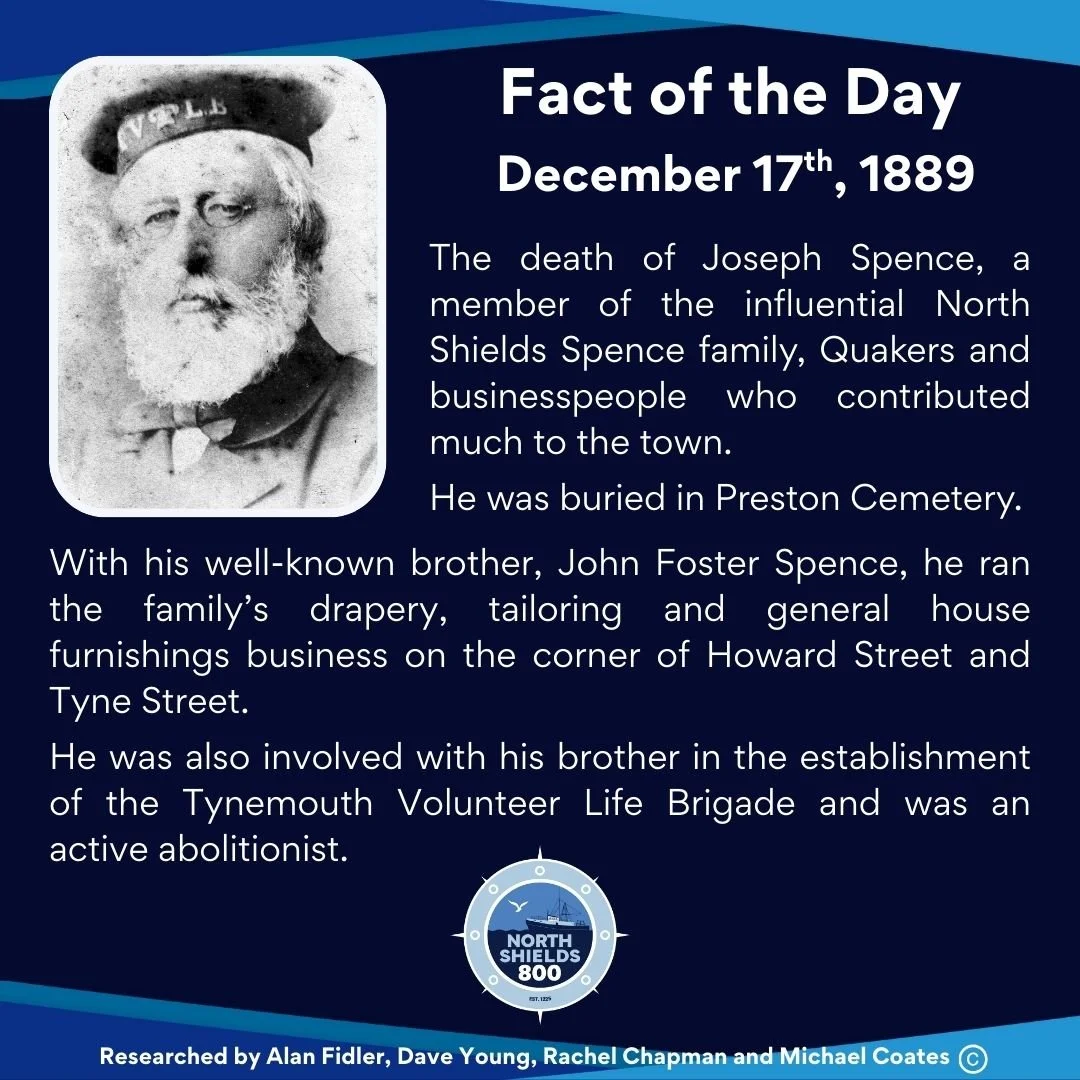
The death of Joseph Spence, a member of the influential North Shields Spence family, Quakers and businesspeople who contributed much to the town. He was buried in Preston Cemetery.
With his well-known brother, John Foster Spence, he ran the family’s drapery, tailoring and general house furnishings business on the corner of Howard Street and Tyne Street.
He was also involved with his brother in the establishment of the Tynemouth Volunteer Life Brigade and was an active abolitionist.
December 18th, 1872
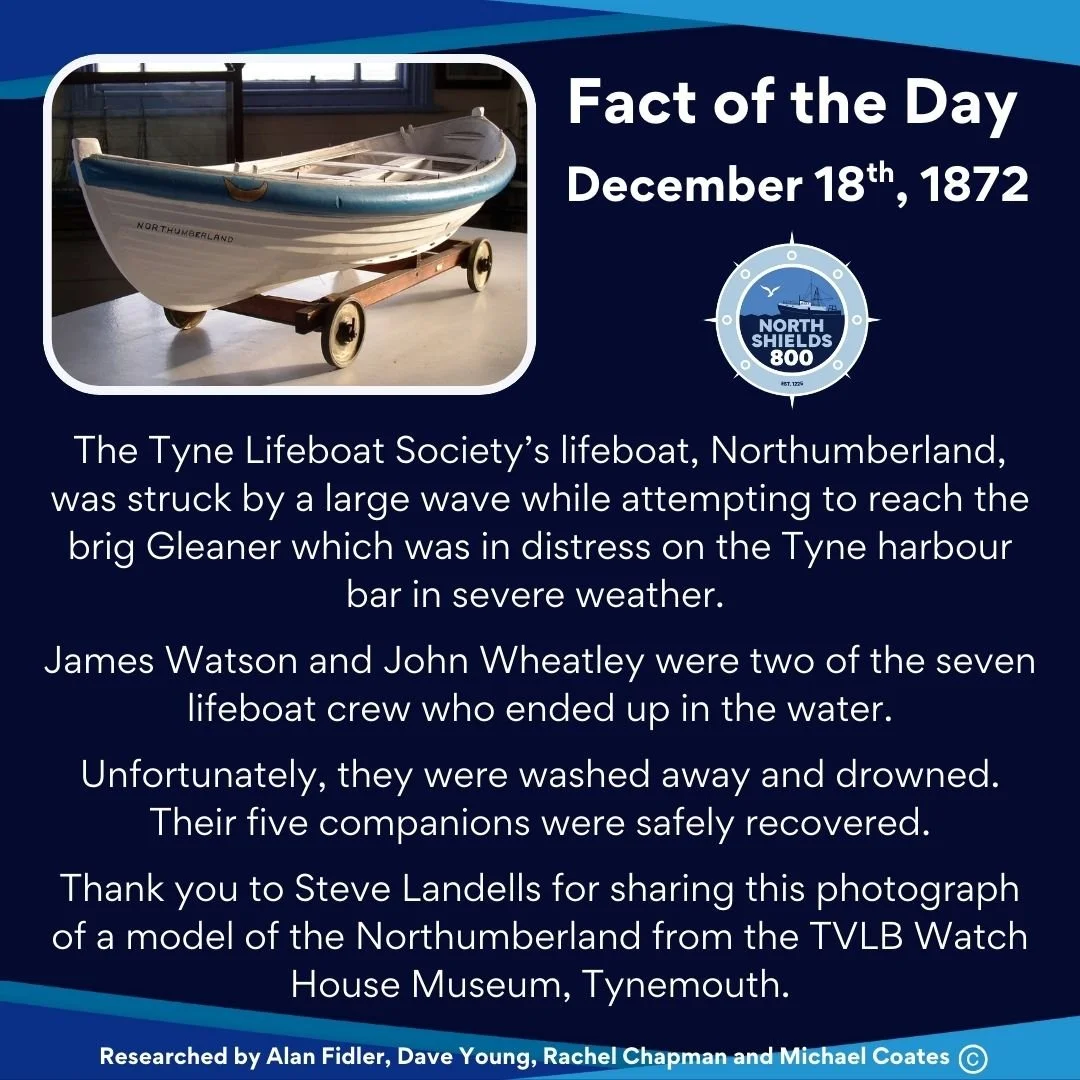
The Tyne Lifeboat Society’s lifeboat, Northumberland, was struck by a large wave while attempting to reach the brig Gleaner which was in distress on the Tyne harbour bar in severe weather.
James Watson and John Wheatley were two of the seven lifeboat crew who ended up in the water. Unfortunately, they were washed away and drowned. Their five companions were safely recovered.
Thank you to Steve Landells for sharing this photograph of a model of the Northumberland from the TVLB Watch House Museum, Tynemouth.
December 19th, 1920
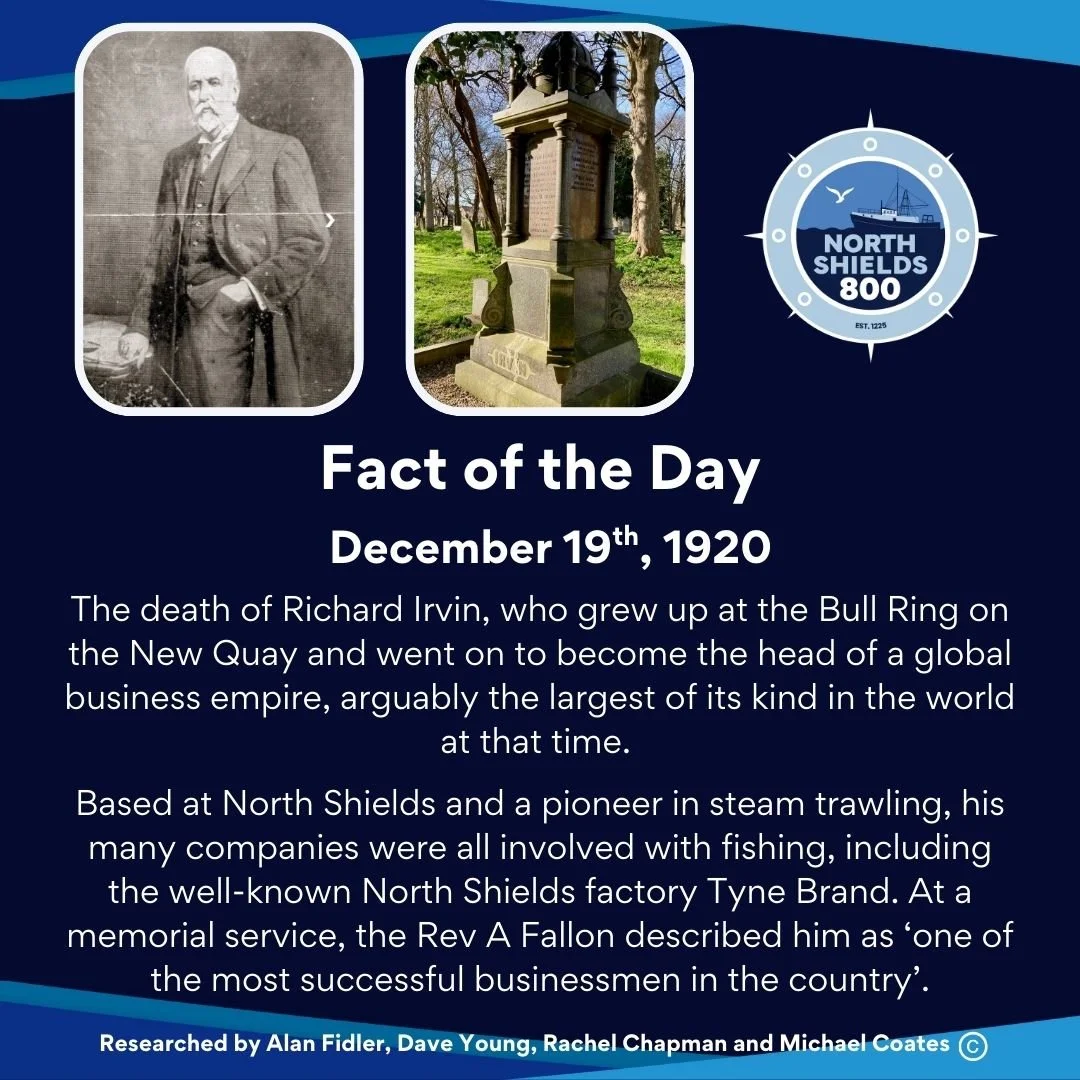
The death of Richard Irvin, who grew up at the Bull Ring on the New Quay and went on to become the head of a global business empire, arguably the largest of its kind in the world at that time.
Based at North Shields and a pioneer in steam trawling, his many companies were all involved with fishing, including the well-known North Shields factory Tyne Brand. At a memorial service, the Rev A Fallon described him as ‘one of the most successful businessmen in the country’.
December 20th, 1752
The right worshipful the mayor, aldermen and common council of Newcastle gave their assent to a request made by Edward Collingwood of Chirton esq. for leave to make a dock at the lower end of North Shields for careening and repairing of ships.
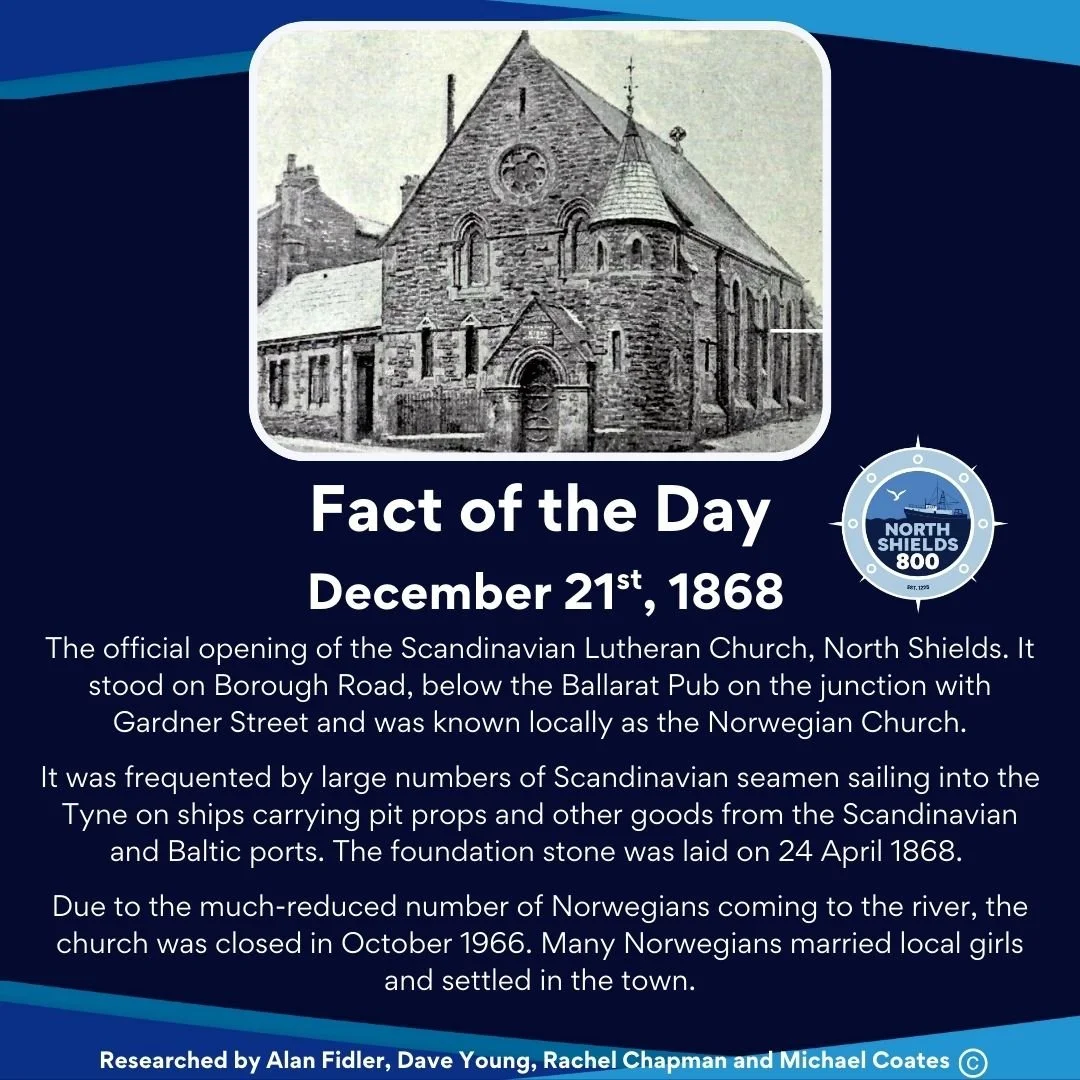
December 21st,1868
The official opening of the Scandinavian Lutheran Church, North Shields. It stood on Borough Road, below the Ballarat Pub on the junction with Gardner Street and was known locally as the Norwegian Church.
It was frequented by large numbers of Scandinavian seamen sailing into the Tyne on ships carrying pit props and other goods from the Scandinavian and Baltic ports. The foundation stone was laid on 24 April 1868.
Due to the much-reduced number of Norwegians coming to the river, the church was closed in October 1966. Many Norwegians married local girls and settled in the town.
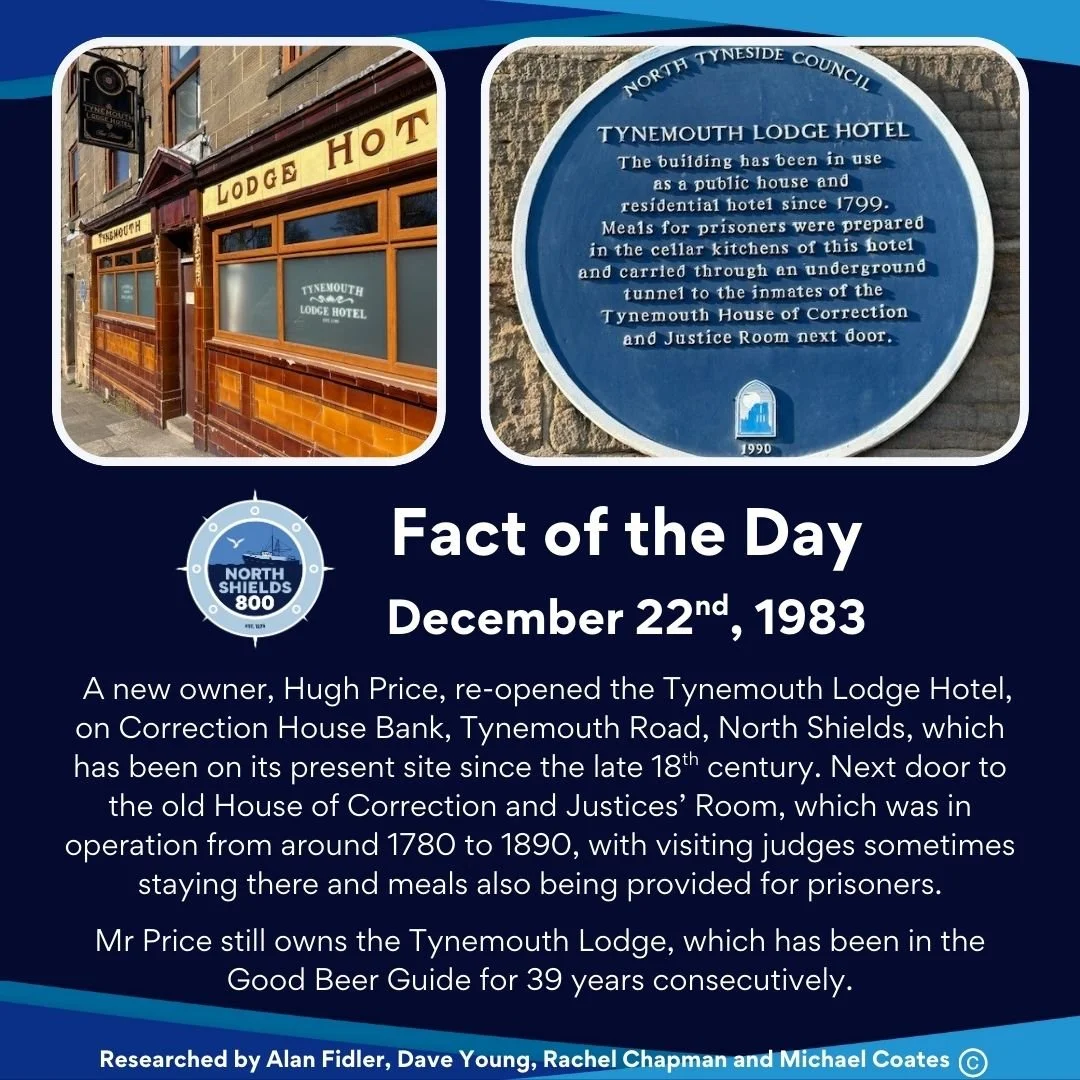
December 22nd, 1983
A new owner, Hugh Price, re-opened the Tynemouth Lodge Hotel, on Correction House Bank, Tynemouth Road, North Shields, which has been on its present site since the late 18th century. Next door to the old House of Correction and Justices’ Room, which was in operation from around 1780 to 1890, with visiting judges sometimes staying there and meals also being provided for prisoners.
Mr Price still owns the Tynemouth Lodge, which has been in the Good Beer Guide for 39 years consecutively.
December 23rd, 1889
Inspector James Anderson of Tynemouth Borough Police was on night duty on the New Quay and in the Low Town. He was last seen in the early hours of December 24th. Evidence seemed to indicate that he fell into the river.
His body was not recovered until January 25th,1890. Whether he was murdered or his death was accidental was never satisfactorily established.
Inspector Anderson lived on Norfolk Street.
December 24th, 1986
The closing service was held at All Saints' United Reformed Church in Verne Road, which had suffered from falling numbers and vandalism.
The church had opened in 1954 as a ‘daughter church’ of St Columba’s Presbyterian Church, Northumberland Square. On its closure, its members ‘greatly enriched worship at Northumberland Square, with many of them performing important leadership roles’.
The Square Building Trust built flats on the site, under the name of All Saints Court.
December 25th, 1831
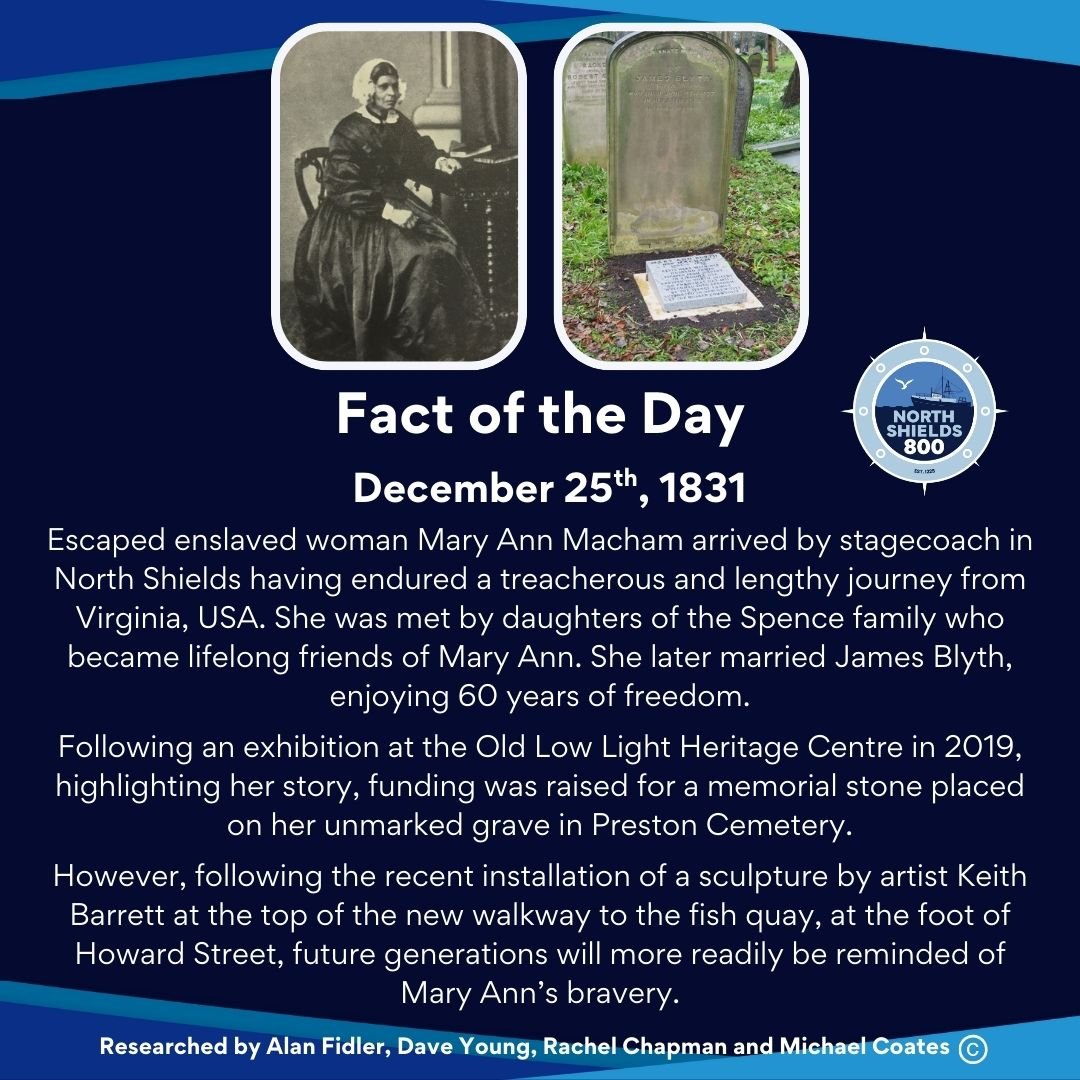
Escaped enslaved woman Mary Ann Macham arrived by stagecoach in North Shields having endured a treacherous and lengthy journey from Virginia, USA. She was met by daughters of the Spence family who became lifelong friends of Mary Ann. She later married James Blyth, enjoying 60 years of freedom.
Following an exhibition at the Old Low Light Heritage Centre in 2019, highlighting her story, funding was raised for a memorial stone placed on her unmarked grave in Preston Cemetery.
However, following the recent installation of a sculpture by artist Keith Barrett at the top of the new walkway to the fish quay, at the foot of Howard Street, future generations will more readily be reminded of Mary Ann’s bravery.
December 26th, 1873
The paddle tug Gipsy Queen sank on the Tyne after colliding with a sunken hopper barge. This resulted in the loss of four crew members and 14 workmen from Tyne Commissioners who were being taken from North and South Shields to their jobs upriver on dredgers to deepen the river and make it suitable for large ships.
December 27th, 1871
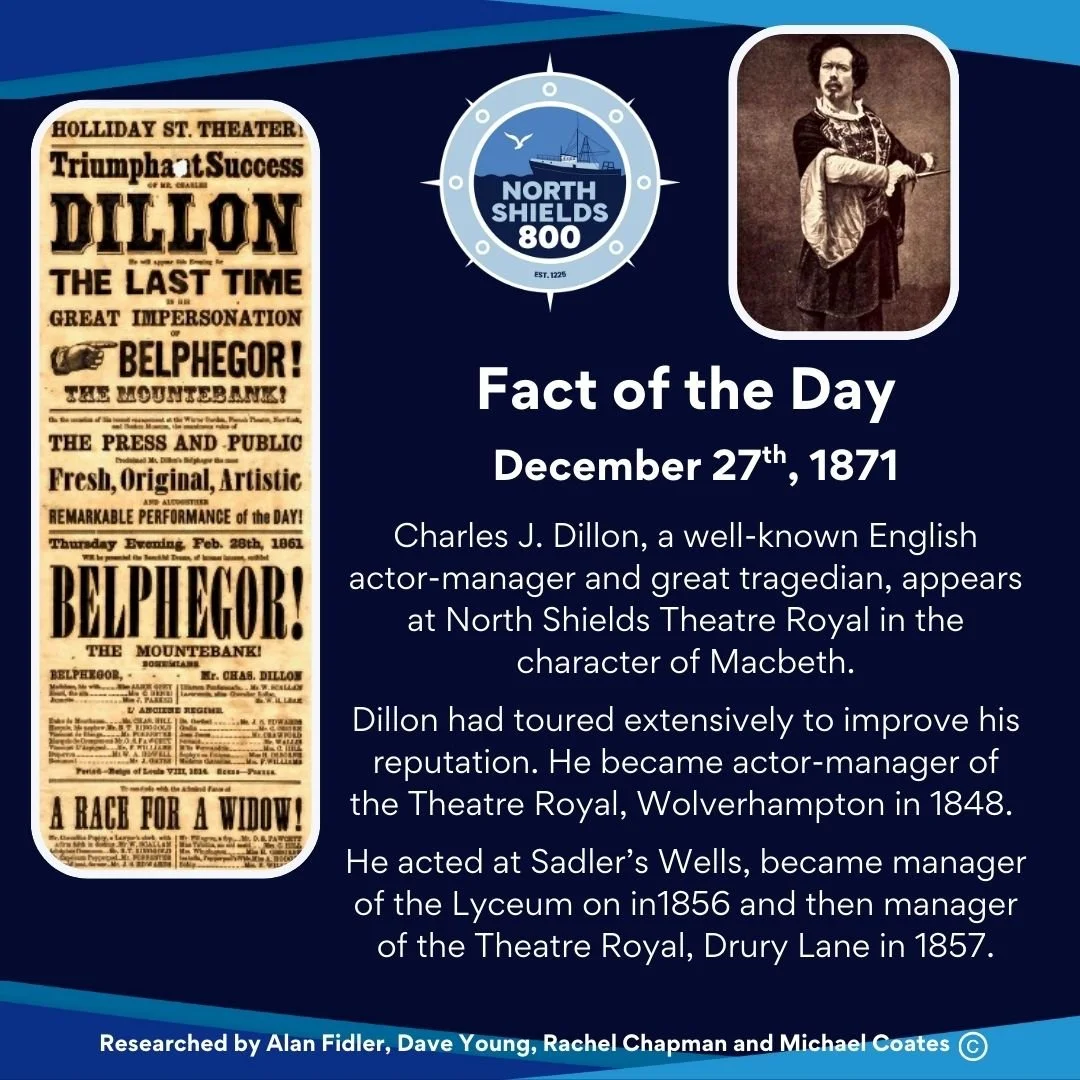
Charles J. Dillon, a well-known English actor-manager and great tragedian, appears at North Shields Theatre Royal in the character of Macbeth.
Dillon had toured extensively to improve his reputation. He became actor-manager of the Theatre Royal, Wolverhampton in 1848.
He acted at Sadler’s Wells, became manager of the Lyceum in 1856 and then manager of the Theatre Royal, Drury Lane in 1857.
December 28th, 1898
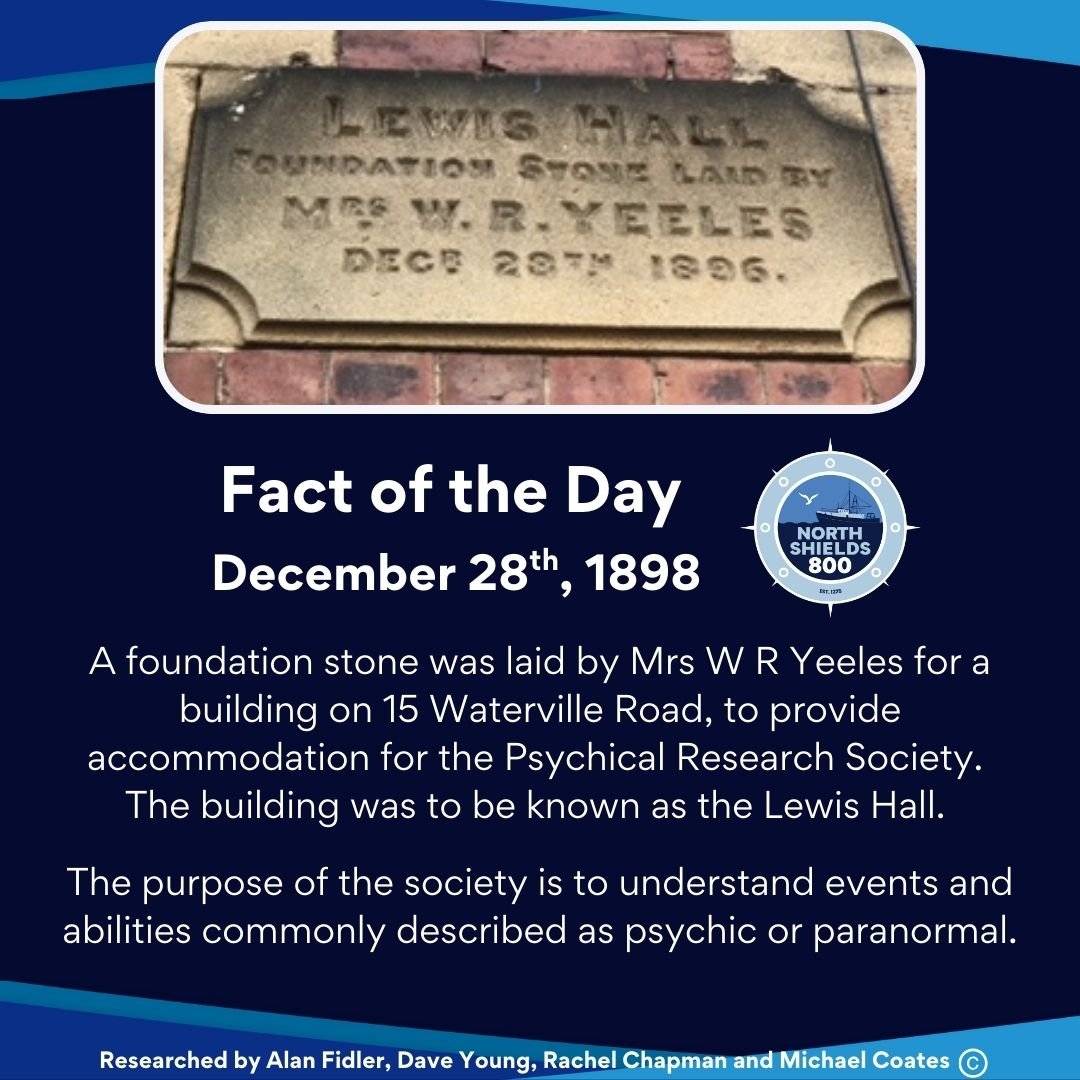
A foundation stone was laid by Mrs W R Yeeles for a building on 15 Waterville Road, to provide accommodation for the Psychical Research Society. The building was to be known as the Lewis Hall.
The purpose of the society is to understand events and abilities commonly described as psychic or paranormal.
December 29th, 1900
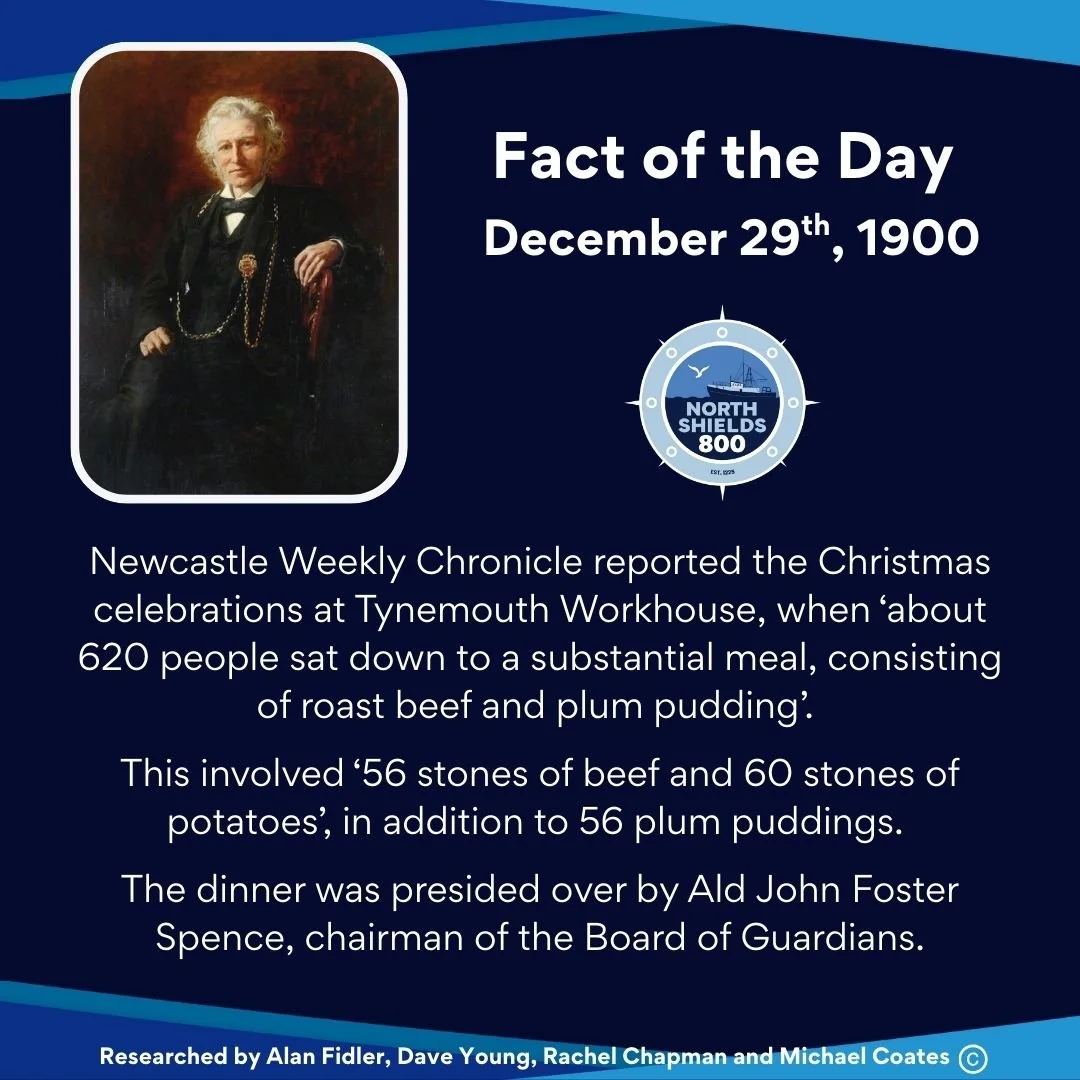
Newcastle Weekly Chronicle reported the Christmas celebrations at Tynemouth Workhouse, when ‘about 620 people sat down to a substantial meal, consisting of roast beef and plum pudding’.
This involved ‘56 stones of beef and 60 stones of potatoes’, in addition to 56 plum puddings.
The dinner was presided over by Ald John Foster Spence, chairman of the Board of Guardians.
December 30th, 1869
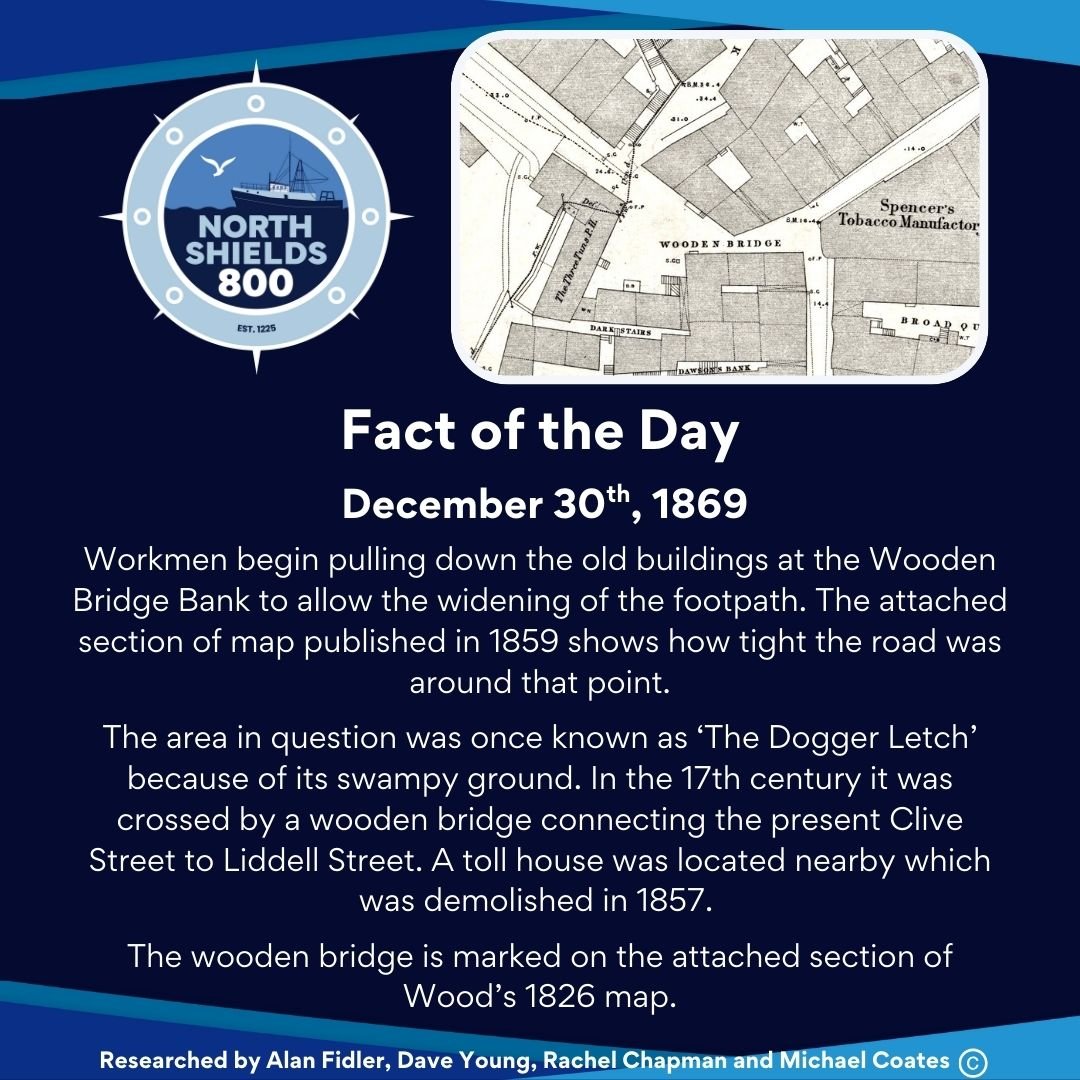
Workmen begin pulling down the old buildings at the Wooden Bridge Bank to allow the widening of the footpath. The attached section of map published in 1859 shows how tight the road was around that point.
The area in question was once known as ‘The Dogger Letch’ because of its swampy ground. In the 17th century it was crossed by a wooden bridge connecting the present Clive Street to Liddell Street. A toll house was located nearby which was demolished in 1857.
The wooden bridge is marked on the attached section of Wood’s 1826 map.
December 31st, 1916
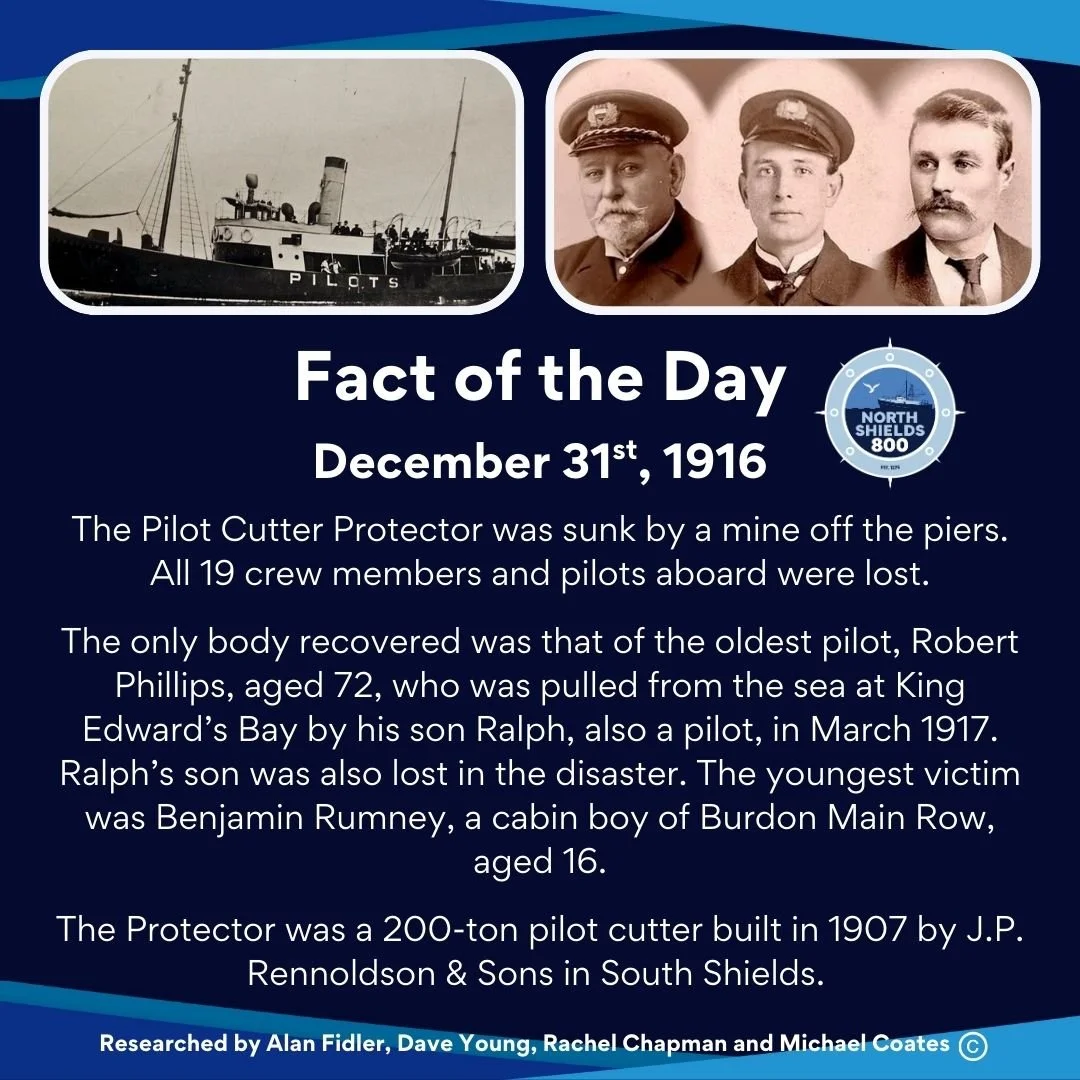
The Pilot Cutter Protector was sunk by a mine off the piers. All 19 crew members and pilots aboard were lost.
The only body recovered was that of the oldest pilot, Robert Phillips, aged 72, who was pulled from the sea at King Edward’s Bay by his son Ralph, also a pilot, in March 1917. Ralph’s son was also lost in the disaster. The youngest victim was Benjamin Rumney, a cabin boy of Burdon Main Row, aged 16.
The Protector was a 200-ton pilot cutter built in 1907 by J.P. Rennoldson & Sons in South Shields.
Pictured are three of the men lost, from left to right: Robert Phillips, Ralph Phillips junior (his grandson) and John Hart Burn from North Shields.